


CHAPTER 3 (PART 4)
NON-FUNCTIONAL CHORDS
Appoggiatura Chords
The appoggiatura chord is named by analogy with the appoggiatura note. An appoggiatura is a note, not normally part of a chord, which displaces a normal note of a chord. The appoggiatura resolves onto the displaced note whilst the chord is still sounding. An appoggiatura, usually (but not always) creates a dissonance with the normal notes of the chord. More than one appoggiatura may be deployed in a chord concurrently. The following example contains appoggiaturas as indicated at *1 and at 2*:
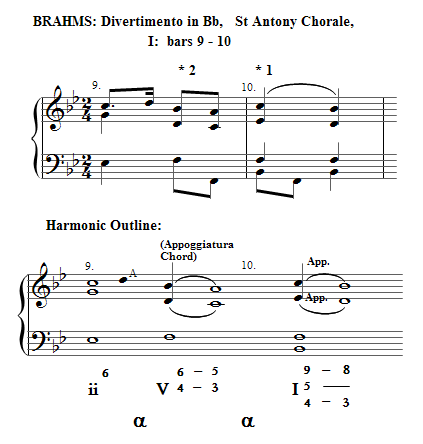
At *1 in bar 10, the two appoggiaturas form discords with the normal notes of the chord and then resolve onto consonant notes of the chord. The C appoggiatura is a compound ninth discord against the B-flat bass and resolves onto a B-flat. This is shown as 9 - 8 in the figured bass under the harmonic outline. The E-flat appoggiatura is a dissonant 7th above the F of the chord and a 4th above the bass. This resolves onto the consonant D. This is shown as 4 -3 in the figured bass.
An appoggiatura note does not create a sense of a change in harmony. However, an appoggiatura chord is an extension of the appoggiatura such that the the way the notes sound in conjunction with the other notes of the chord create an impression of a change in harmony. Appoggiatura chords are non-functional and the chords onto which they resolve are functional. This is because appoggiatura chords merely elaborate the functional harmony. Their purpose is to prolong the functional chord. Appoggiatura chords are used most commonly to decorate and extend the cadence. The reason for giving these chords a special name is because they are capable of being confused with genuine functional chords. In reality, they arise out of voice leading movements just as other surface voice leading patterns do.
At *2 in bar 9 (in the above example) the two appoggiaturas: B-flat and D take over from the normal notes of the chord (A and C) and here form a new chord - the tonic chord in second inversion. This is normally referred to as the cadential 6 4 chord because the upper notes are a (compound) 6th and 4th above the bass of the dominant chord of the cadence. This is the most common type of appoggiatura chord. The appoggiatura chord is shown here as black note heads with a stem. I've shown them this way because cadential 6 4 chords are frequently elaborated by further levels of voice leading and this will enable us to distinguish the levels. See Voice Leading Patterns Combined in the Voice Leading Appendix for more on this. Note that in the example above, the appoggiatura chord in bar 9. is of shorter duration than the appoggiatura notes in bar 10. Duration is not the main consideration for this type of voice leading elaboration.
There are three main types of the appoggiatura chord as indicated in the following harmonic outlines: These are all mostly associated with the elaboration of cadential dominant and tonic chords (but not exclusively). They are used extensively as means of emphasising that the chords are part of the cadence.
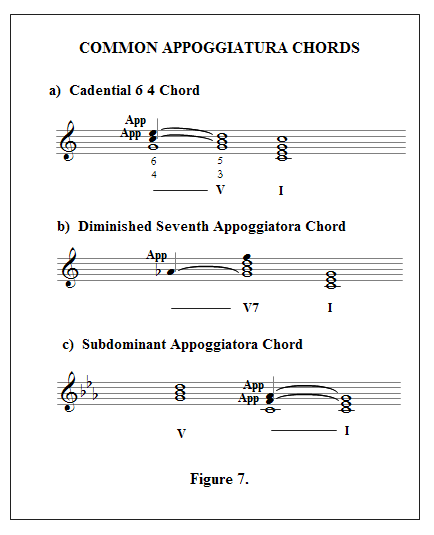
The chord marked as *2 in the example above is an example of Figure 7 a). Cadential 6 4 chords, with or without further elaboration are very common and the reader will find further examples very easily.
Examples of the appoggiatura chord b) are not as common as the cadential 6 4. However, they are are sometimes used to decorate a dominant seventh chord at the cadence or in a chord progression or as a melodic device. In the following strong chord progression the A-flat decorates the dominant 7th chord at bar 112 to form a temporary diminished 7th appoggiatura chord:

This same chord progression can also be seen in Beethoven: Pathetique Sonata: Grave, bars 7 to 9 and in the first prelude of Bach's 48 Preludes and Fugues.
It is important at this stage to emphasis the difference between a passing chord and an appoggiatura chord. A passing chord is made up of passing notes plus notes from the preceding chord. An appoggiatura chord is made up of one or more appoggiaturas plus notes from the following chord. In the last example, the A-flat is an appoggiatura and the remaining notes are notes from the following (G7) chord. The passing chord moves away from a chord and the appoggiatura chord leads into and decorates the following chord.
The following is an example of c) in which the appoggiatura chord decorates the cadential tonic chord. Note that the appoggiatura chord appears in root position (if we take the lowest note of of the arpeggiated bass line) suggesting its status as an independent chord. It is, nevertheless made up of two appoggiaturas plus notes from the following tonic chord and is consequently a non-functional chord: The downward movement of one of the appoggiaturas is further elaborated by a chromatic passing note as indicated in the harmonic outline. This highlights the reason for showing the appoggiatura chord notes with stems as explained above.
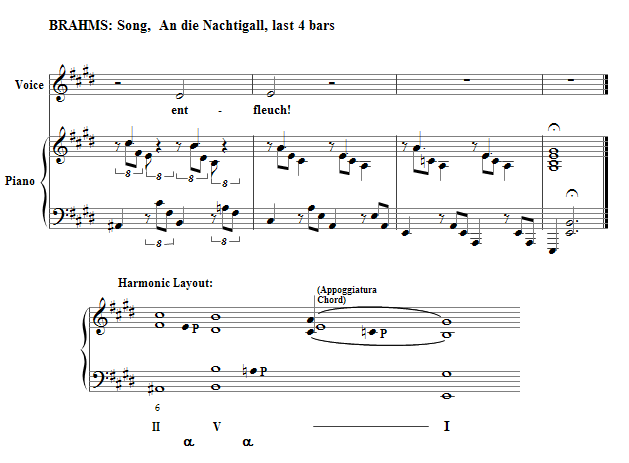
This progression is of particular interest to readers studying harmony in popular music as it forms the basis of the standard cadential pattern for the 12 bar blues progression. This normally has the 7th added to each of the chords as follows but the chord progression is the same:
V 7 - IV 7 - I 7
For more information on this then please refer to Appendix A: The Blues Progression
Puccini's aria Nessun Dorma ends with the same cadential pattern, showing the influence of the blues on this early 20th century piece.
Note: There is more information on the appoggiatura and appoggiatura chords in the Voice Leading Appendix.