


CHAPTER 4
LINEAR PROGRESSIONS
Where a chord progression arises out of a step by step movement in one or more voices rather than by root progression, I will refer to these progressions as 'linear progressions'.
Those readers who are familiar with Schenker's theory should note that the use of the term 'linear progression' in this book is similar to, but not exactly the same as that by Schenker. In this book, the term is used more in line with 16th century polyphony and the traditional rules of voice leading, rather than in the extended way used by Schenker. By limiting its use in this way, the relationship between root progressions and voice leading can be more clearly described than in pure Schenkerian theory.
In the last chapter, the passing chords were created by passing notes in one or more voices resulting in a single chord filling in between two functional chords. An important extension of this pattern is a series of chords created by a step by step movement in one or more voices. I will refer to this as a linear progression. The succession of filling in chords is neither recognisable as static harmony nor as dynamic harmony. This does not mean, however, that the linear progression is a third type of movement. This is because linear progressions are always incorporated within static or dynamic patterns. The chord succession results out of the linear movement of one or more voices rather than a root movement. A linear progression may be either diatonic or chromatic or a mixture of both and may involve more than one voice in parallel motion or in contrary motion. Where there are concurrent linear progressions these may sometimes move at different rates. This type of movement has its origins in 16th century polyphony. (See Auxiliary Notes and Linear Progressions in the Voice Leading Appendix) The reason for giving this type of movement a special name is not because it has a special significance but because it is capable of being confused with a genuine functional root progression. In reality, it arises out of voice leading movement just as other surface voice leading patterns do. The only real difference with other types of voice leading patterns is that linear progressions can operate over a longer duration.
The stepwise movement is always contiguous. If there is a break in the
step wise movement then the progression is not a linear progression. In
general, the same rules as for passing chords are apparent: The passing
chords in the linear progression are made up mainly (if not completely)
of notes retained from the starting chord and linear moving notes. Occasionally,
chromatic auxiliary notes are also deployed. This is because of the way
that voice leading patterns can be combined. See Combined
Species.
Linear Progressions in Static Harmony
Linear progressions in static harmony can link successive tonic chords or link the tonic chord to an auxiliary chord involved in the static harmony, in which case the auxiliary chord behaves as a functional chord and is normally in root position.
The following example contains just about the simplest kind of linear progression possible. It is totally diatonic, it is created by a linear movement between two successive tonic chords and is not extended by any further elaboration other than surface arpeggios and passing notes.
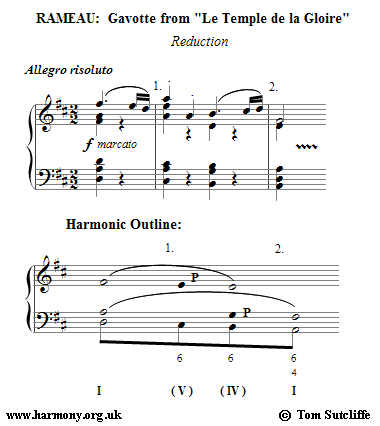
It may seam at first sight that this is a I - V - IV - I progression but on further examination it is clear that the succession is driven by a linear descending bass pattern: D - C# - B - A, linking the D in the tonic chord in the upbeat bar to the A in the tonic chord in bar 2. As well as this linear movement there is a parallel downward stepwise movement: F# - E - D and also: A - G - F#. Although, neither of these linear movements stays in the same voice and both are effectively just passing note patterns as there is only one note between successive structural notes. Note that the common properties normally observed in linear progressions are present: The chords involved in the linear progression are made up of the notes of the starting chord and notes which are moving (i.e. taking part in the linear progressions). Hence, the A (first beat, bar 1) and the D (first beat bar 2) are retained as starting chord harmonies against the other notes that are involved in the movement. This is a voice leading movement rather than a chord progression. The static harmony then continues for several bars. The harmonic outline shows the structural notes as white note heads and the voice leading filling in notes as black note heads. The beam is used to connect the notes involved in the linear movement. Slurs are used to connect notes arpeggiated within the structural tonic chord. The two passing chords created by the linear progression are shown in brackets to highlight the fact that they are not structural chords. See Voice Leading Appendix.
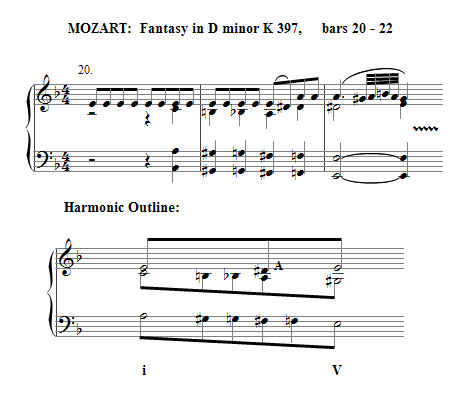
Chromatic linear progressions are more common than diatonic linear progressions as there are more possibilities. Following is an example of a chromatic linear progression within static harmony. Like the previous example, the bass voice descends from the tonic note to the dominant but this time by 5 semitone steps. A middle voice follows the linear progression in parallel minor thirds, whilst a further voice decorates with a chromatic auxiliary note. The minor third, or the compound interval of the minor 10th or its inversion, the major 6th, are the most common intervals for chromatic linear progressions moving in parallel motion. The linear movement is accompanied by notes sustained from the staring chord (A minor): E and A, as is normal for linear progressions. In this instance, the harmonic movement is from Chord I to chord V. Note: This piece is in D minor (hence the D minor key signature) but this section is in A minor.
At bar 26, in the same composition, Mozart employs a combination of diatonic and chromatic linear progressions in contrary motion. There are three linear progressions in all: two rising in parallel thirds and one descending. In spite of this complexity the harmonies produced make perfect sense. However, it is important to note that the preparation and resolution of the discords are governed here by the rules that apply to linear progressions rather than the rules that would normally apply to structural chords. This fact underscores the voice leading nature of this and other voice leading progressions. The progression is again within static harmony and starts and ends on the tonic chord. Note: this section is in A minor.
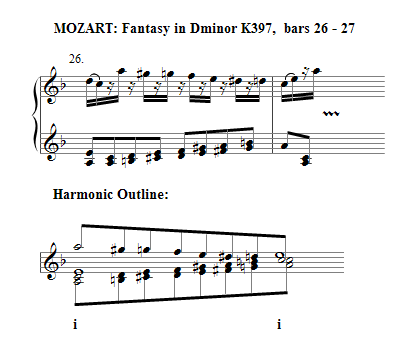
The descending line is in semitones apart from one tone (from G to F) and the ascending scales are diatonic apart from an augmented 2nd from F to G#.
Linear Progressions in Dynamic Harmony
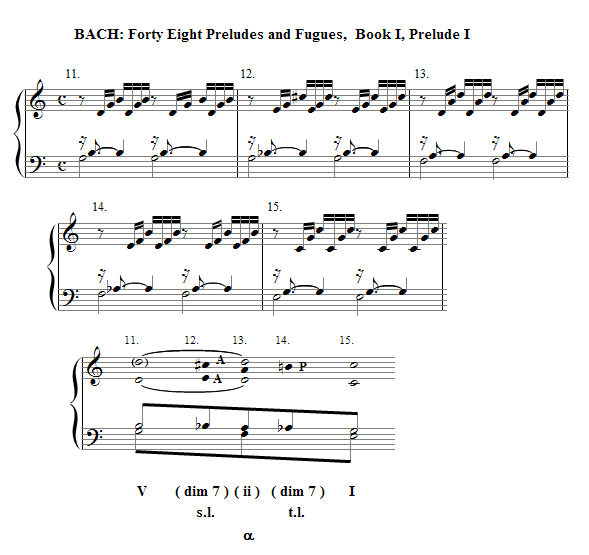
The following example includes a linear progression moving chromatically from the dominant chord to the tonic. The underlying harmony is dynamic as the dominant is preceded by chord II and the tonic followed by chord IV. The purpose of the linear progression is to temporarily delay and extend the movement of the dynamic harmony. Whilst diatonic linear progressions are deployed most frequently in the bass and sometimes also in the melody, chromatic linear progressions are sometimes used in a middle voice, as here. The linear progression is driven by the the line which descends: B , Bb , A - Ab - G in the tenor voice . The G from the starting chord is retained in bar 12 in the bass but then forms a passing note F which descends to the E in the ending chord. It involves: two diminished 7th chords (one supertonic leading; one tonic leading) and one triad (the supertonic). The normal rules about linear progressions are followed. The chords in bars 13 and 14 retain the D from the starting chord even though this is temporarily displaced in bar 12 by the C# and E auxiliary notes.
Linear Progressions Elaborating Dominant Harmony
The third area where linear progressions are important is in the prolongation of the dominant chord. This is similar to the use of linear progressions in tonic static harmony. However, as we have not yet examined the prolongation of the dominant harmony, I will leave this subject until Chapter 5.
There is also a description of the linear progression in the Voice Leading Appendix at: Auxiliary Notes and Linear Progressions and Chromatic Linear Progressions.