


CHAPTER 3 (PART 2)
NON-FUNCTIONAL CHORDS
Auxiliary Chords
Auxiliary chords are formed by the stepwise movement (up or down) of one or more of the voices away from a harmony note in one chord to form a new chord. The voice(s) then return to the originals note(s) to re-form the original harmony. Normally the auxiliary chord is made up solely of notes from the original chord plus notes involved in the auxiliary movement. In this case they arise totally out of voice leading. (But see note below on auxiliary chords in root position). These auxiliary chords are non-functional whereas the tonic chords surrounding them are functional. This is because the auxiliary chord merely elaborates the main functional chord, its purpose being to prolong the functional harmony. Auxiliary chords are used extensively to prolong the tonic harmony in static harmony as explained in Chapter 2. They can also be used to extend the dominant to form a dominant prolongation. (See Chapter 5). Sometimes auxiliary chords can be used to decorate individual chords in dynamic harmony especially where this is slow moving but this is not as common.
The auxiliary chord is named by analogy with the auxiliary note. The following example contains auxiliary notes marked with an "A":
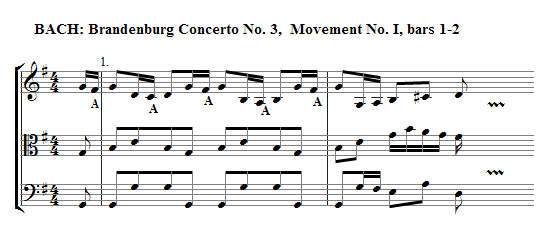
The short duration of the auxiliary note does not create a feeling of a change in the harmony. An auxiliary chord, is an extension of the auxiliary note such that the duration of the auxiliary note and the way the note sounds in conjunction with the other notes of the chord, creates a sense of a change in harmony. This type of chord has its origins in 16th century polyphony. See Voice Leading Appendix: Auxiliary Notes and Linear Progressions for more details.
Using the analytical symbols introduced earlier, the following harmonic outlines indicate some of the possible auxiliary chords within the diatonic major scale:
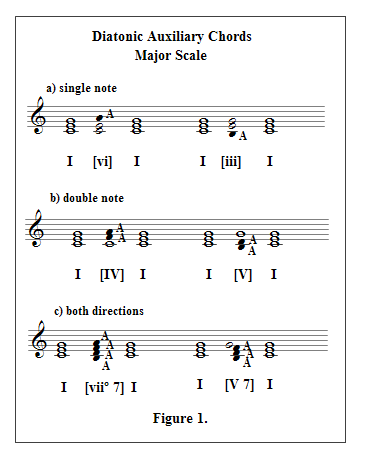
White headed notes are components of the functional chords and the black headed notes are the result of voice leading. The letter "A" indicates an auxiliary note.
The examples marked a) are not very common (at least in the inversions shown) as they generate the secondary triads vi and iii. I've shown these in lower case letters to hightlight the fact that they are minor.
The examples marked b) are very common since they generate the primary triads IV and V by the simultaneous auxiliary movement of two voices.
The following example includes both chords of b) and also an example of the second of c), the V7 chord.
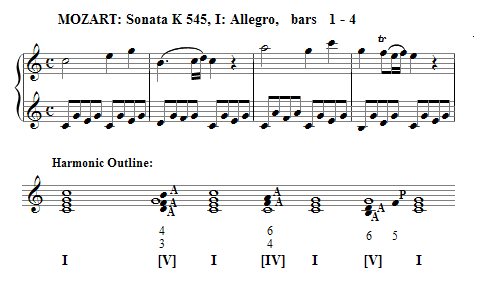
In bar 2, the lower C rises to D and returns, the higher C falls to B and returns, and the E rises to F and back. These three auxiliary notes (shown as "A") create a dominant 7th auxiliary chord. In bar 3 the E rises to F and returns to the E whilst the G rises to A and returns to G. The C major chord is thus transformed temporarily to an F major auxiliary chord. In bar 4 the E and C descend to D and B and return to E and C thus briefly creating an auxiliary dominant G chord. The melodic line in bar 4 also contains an F which forms a 7th to the dominant chord, but in this case as a descending passing note which is further elaborated by a short auxiliary note E. For simplicity this is shown an octave lower in the outline. The passing note is shown as "P".
Similar auxiliary chords may be drawn up for the minor key, In this case, the 7th degree of the scale is usually sharpened to form the major chord V.
The following figure shows some of the common possibilities involving chromatic harmonies:
.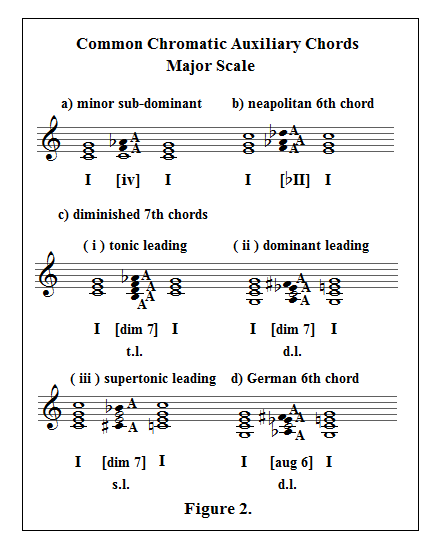
The examples a) and b) involve movement in one direction only. a) contains two auxiliary notes: one diatonic, E rises to F and returns to E, and one chromatic: G rises to A-flat and returns to G. The auxiliary chord formed is the minor subdominant chord which occurs naturally in the minor key. In b) all three notes of the tonic triad rise a semitone and then return to the original notes. This chord is usually referred to as the Neapolitan 6th chord and is usually deployed in first inversion to avoid the parallel 5ths that would otherwise arise.
The next three auxiliary chords in c) (i), (ii), (iii) are the three possible diminished 7th chords. I've shown all three for completeness and to introduce the terminology to be used for each of these. See below. (i) and (ii) are common auxiliary formations, but (iii) is more usually deployed as a passing chord between I and II as the C - B-flat movement has a tendency to continue downward to A rather than to return to the C. (see next section - passing chords). The example c) (ii) could be shown with a D# instead of the Eb. Please see note below on naming of chromatic chords.
Example d) is an example of the "German" version of the augmented 6th chord, created by three chromatic auxiliary notes all moving a semitone and back. The Eb could also be shown as a D# auxiliary note but is usually shown as Eb in this situation.
Auxiliary Chords in Root Position
Sometimes auxiliary chords are used in root position (could be any triadic chord). In this situation, they are not composed entirely of voice leading (notes of the main chord plus auxiliary notes) because of the way the bass moves from one root to another and sometimes because of other voice movements. These chords will nevertheless be referred to as auxiliary chords, by analogy with the auxiliary note, because of the way the chord returns to its preceding chord and because these root position chords are also used to create static harmony. In this situation, it is possible to have, in addition, passing chords that fill in between the main chord and the auxiliary chord. So there are really two types of auxiliary chord: those that are in root position and are capable of further elaboration are really functional chords and those that arise totally out of surface voice leading which are non-functional. In either case, they can be used to create static harmony. The distinction between these two types of auxiliary chords does not normally create too much difficulty because both types are used in similar ways. In different styles of music, many different chords (diatonic and chromatic) have been used as auxiliary chords to create static harmony and in this way, the choice of auxiliary chords contributes significantly to the style and mood of the music in particular as this occurs at the start of the musical phrase. Please refer to Chapter 2 and the Full Analysis Chapter for further examples.
Description of Chromatic Chords
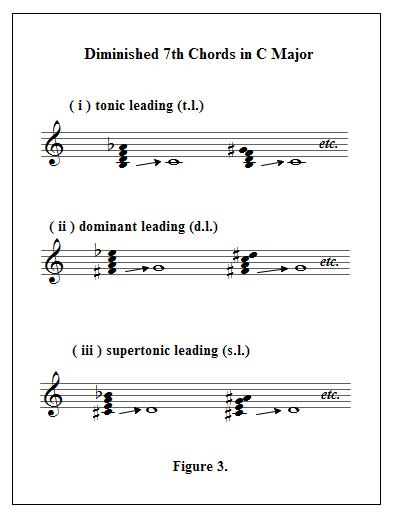
This is an appropriate point to introduce the terminology to be used in this book for chromatic harmonies, in particular the diminished seventh chord. The following figure demonstrates some of the possible diminished 7th chords in C major. Most books treat these as borrowed from related or unrelated minor keys or as dominant substitute chords. However as neither of these designations accurately describes the true function of the chords, I will introduce an alternative, simpler, terminology which acknowledges the voice leading rather than harmonic function of the these chords. I will use the terms: tonic leading, dominant leading and supertonic leading to describe the three possibilities regardless of the particular spelling of the chord. The tonic leading diminished seventh chord is named in this way because it contains the leading note which leads to the tonic, the dominant leading diminished seventh chord contains the sharpened 4th degree of the scale which leads to the dominant and the supertonic leading diminished seventh chord, because it contains the sharpened tonic which leads to the supertonic note. This terminology makes identification and discussion easier and highlights the voice leading function of these chords.
In the following example, Tchaikovsky uses the tonic leading diminished 7th chord as an auxiliary chord in the static harmony in Valse Des Fleur. The static nature of the harmony is emphasised by the use of a tonic pedal which is sustained below the diminished 7th chord in spite of the dissonance between the D, C# and E.
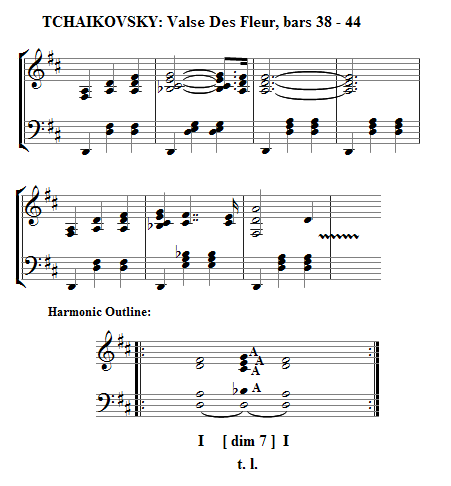
This chord creates a colourful effect that represents the flowers in the title and is therefore a further example that demonstrates that the type of auxiliary chord used in static harmony is an indicator of the style or mood of the music.
There will be further examples in the full book.
There is also a description of the auxiliary note and auxiliary chords in Chapter 2 and the Voice Leading Appendix.